
AI contract review is a fast first-pass diligence read of a live contract. For a buyer, its job is not to replace counsel. It should quote risky clauses, flag missing protections, assign a risk score from 1 to 10, and tell you which issues belong in the attorney review. It is most useful on APAs, LOIs, FDDs, commercial leases, seller notes, employment agreements, NDAs, vendor contracts, and disclosure schedules.
The right question is not whether software can summarize a contract. The buyer question is sharper: can it find the clauses that change price, closing risk, recovery, leverage, or post-close exposure before the document goes to counsel?
Quick Answer
Use AI contract review when you need a structured first pass on a deal document before you spend attorney time. It should help you decide whether the contract is:
- low enough risk to continue diligence
- negotiable but not a walk-away issue
- high enough risk to escalate before signing
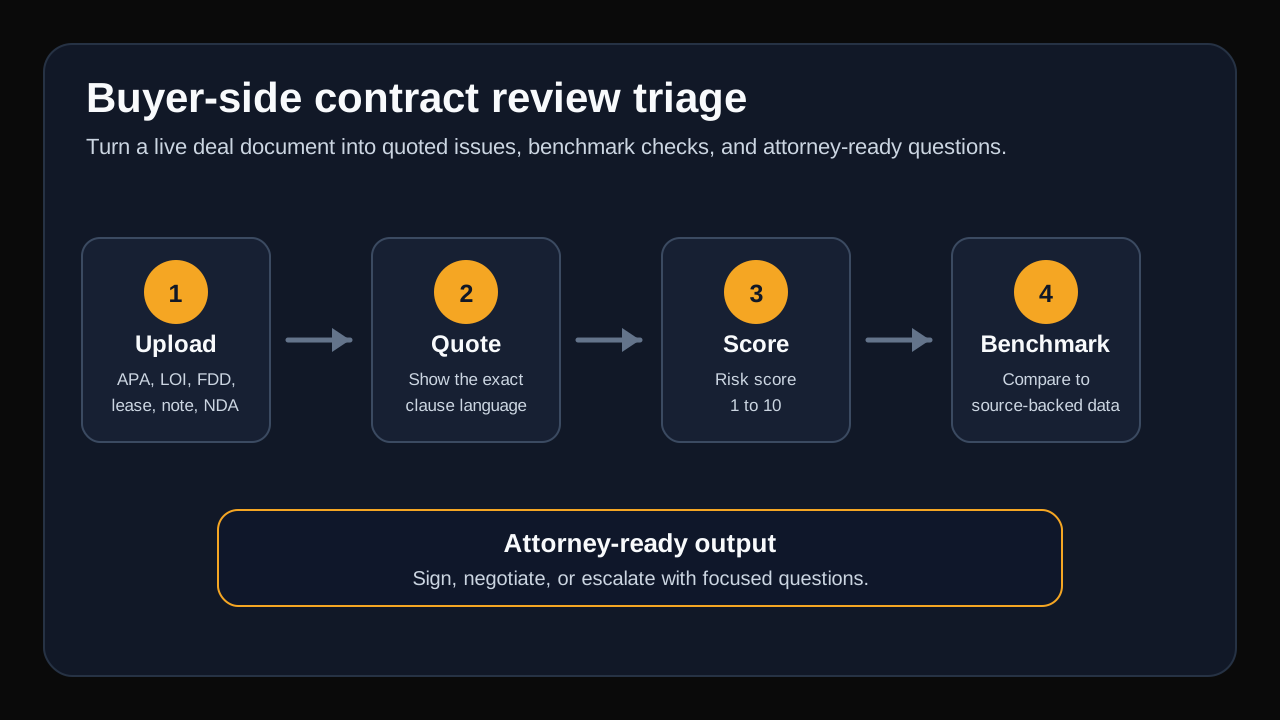
For self-funded buyers, the best use is triage. Upload the live document, read the quoted clauses, check the risk score from 1 to 10, then turn the report into better questions for counsel.
Buyer Decision Table
| Buyer situation | Use AI contract review for | Escalate to counsel when |
|---|---|---|
| APA or purchase agreement | Indemnity, survival, escrow, working capital, seller covenants, closing conditions, disclosure schedule gaps | The report flags a risk score of 7 to 10, a missing recovery source, a customer concentration issue, or a mismatch between the APA and schedules |
| LOI | Exclusivity, binding sections, deposit treatment, diligence rights, break fees, financing conditions | The LOI limits diligence, makes too many terms binding, or gives the seller leverage before financing is ready |
| FDD and franchise agreement | Item 7 cost range, Item 19 claims, fees, territory, renewal, transfer, termination, personal guarantee | The FDD cost range does not match the buyer model, Item 19 is thin, or the agreement shifts operating risk back to the buyer |
| Commercial lease | CAM, assignment, renewal, use restrictions, repair, restoration, guarantee, notice deadlines | The lease blocks assignment, adds uncapped pass-through costs, or requires a personal guarantee the deal model cannot absorb |
| Seller note or SBA-financed deal document | Standby terms, subordination, default triggers, cure periods, payment schedule | The note is meant to count toward buyer equity or conflicts with current SBA standby requirements |
| Vendor, NDA, or employment agreement | Confidentiality, non-solicit, IP assignment, data rights, liability cap, termination | The agreement touches customer lists, retained employees, transition services, or post-close operating continuity |
What AI Contract Review Should Actually Do
A serious first-pass review should do more than summarize. For a buyer, it should produce decision support.
At minimum, the report should:
- identify the document type and buyer context
- quote the clause that creates the issue
- explain the business consequence
- flag missing protections
- assign a risk score from 1 to 10
- identify uncertainty instead of guessing
- point to the next attorney question
If a report only says the contract "looks risky" without showing the language, it is not enough. The buyer needs the clause, the consequence, and the next action.
Why Buyer-Side Review Is Different
Most contract software content is written for in-house legal teams. That is not the same buyer.
An in-house legal team usually wants playbooks, intake queues, approval workflow, redlines, repositories, and renewal tracking. A self-funded buyer under LOI wants something else:
- Does this APA leave me with post-close losses I cannot recover?
- Does the seller note match SBA standby rules?
- Does the commercial lease assign cleanly at closing?
- Do the disclosure schedules contradict the seller's representations?
- Does the FDD cost range match the capital I actually need?
- Which issues should I pay counsel to focus on first?
That is why Inkvex frames review around live-deal diligence instead of legal operations workflow. The output is built to prepare the buyer for counsel, not to manage a legal department.
What It Catches Well
AI contract review is strongest where the contract has repeatable structure and the risk can be tied to words on the page.
Quoted red flags
Strong review should catch familiar buyer-side risk patterns:
- broad indemnification without a practical recovery source
- low liability caps
- short survival periods
- missing escrow or holdback
- weak closing conditions
- broad non-solicit or non-compete language
- assignment restrictions in a lease or vendor agreement
- renewal traps and notice deadlines
- customer concentration language hidden in schedules
The key is quotation. A buyer should be able to see the exact words that created the issue.
Missing protections
Bad contracts are not only dangerous because of what they include. They are dangerous because of what they omit.
For an APA, missing protections can include a thin escrow, no fraud carve-out, no seller covenant tied to customer concentration, or no financing condition. For an FDD, the issue might be a cost range that excludes real estate. For a lease, it might be assignment consent without a reasonableness limit.
That is where benchmark-linked review matters. A clause can look normal until it is compared with a market baseline or a primary-source rule.
Fast triage before attorney time
Attorney time is most valuable when it is focused. A first-pass report should narrow the review to the clauses that matter:
- risk score 1 to 3: likely routine, confirm before signing
- risk score 4 to 6: negotiate or clarify
- risk score 7 to 10: escalate before relying on the document
The score is not the decision. It is the sorting layer that tells the buyer where to spend judgment.
Where Benchmarks Change the Review
A buyer-side report gets stronger when it can compare the clause to a source-backed baseline.
Inkvex has been building that layer around proof objects:
- APA Indemnity Risk Map benchmarks 9 indemnification terms from the 2025 ABA Private Target M&A Deal Points Study.
- FDD Item 7 Investment Benchmark compares Item 7 investment ranges for dozens of franchise brands, each with its FDD year; only some rows publish an exact filing locator.
- SBA Seller Note Standby Rules maps the SBA SOP 50 10 8.1 standby treatment (effective October 1, 2026) for buyer-financed deals.
- Commercial Lease Red Flags organizes recurring lease risk patterns for acquisition and franchise buyers.
That is the difference between a generic contract summary and a diligence report. A summary tells you what the clause says. A benchmarked review tells you whether the clause should worry a buyer.
Primary Sources Used for This Refresh
This page is built around primary or source-of-record materials, not competitor blogs.
- SBA SOP 50 10, version 8.1 effective October 1, 2026, for seller-note standby and SBA-financed acquisition review.
- IRS Sale of a Business, for the tax framing that a business sale is usually a sale of separate assets rather than one undifferentiated item.
- The Inkvex APA Indemnity Risk Map, which preserves the ABA 2025 Private Target M&A Deal Points Study benchmark layer for buyer-side indemnification terms.
- The Inkvex FDD Item 7 Investment Benchmark, which preserves the Item 7 source rows used for franchise cost review.
Contract Types Where It Helps Most
APAs and purchase agreements
For an acquisition buyer, the APA is where the major risk allocation happens. AI contract review is useful when it flags indemnification, baskets, caps, survival periods, escrow, fraud carve-outs, working-capital adjustment mechanics, closing conditions, and disclosure schedule gaps.
Start with the APA checklist for SMB buyers and the APA indemnification red flags guide when the report surfaces recovery issues.
LOIs
An LOI can quietly lock the buyer into exclusivity, confidentiality, deposit terms, break fees, and diligence timelines before the full agreement is ready.
AI contract review helps by separating binding from non-binding terms and showing where the buyer gives up leverage too early.
FDDs and franchise agreements
For a franchise buyer, the review should connect the FDD to the franchise agreement. Item 7 tells the buyer the investment range, Item 19 frames performance claims when present, and the agreement controls fees, territory, transfer, renewal, termination, and guarantees.
Start with FDD Scan, FDD review checklist, and the FDD Item 7 benchmark.
Commercial leases
In acquisition and franchise deals, the lease can decide whether the deal works. Assignment, use restrictions, CAM, repair obligations, renewal rights, restoration, and personal guarantees can change the buyer's model.
Use commercial lease review and the commercial lease red flags benchmark when the location matters to the deal.
Seller notes and financing documents
Seller financing can be useful, but the terms need to match the financing plan. If a seller note is being counted toward the SBA equity injection, standby language matters.
The current source for that issue is SBA SOP 50 10, and the buyer-facing map is SBA seller note standby rules.
Vendor, NDA, and employment agreements
Deal diligence does not stop at the APA. Vendor contracts, broker NDAs, retained-employee agreements, transition services, and data agreements can all affect closing and post-close operations.
Use the report to find renewal traps, non-solicit language, IP assignment, data rights, service obligations, and termination limits.
When AI Review Is Not Enough
There are moments where first-pass review should lead directly to counsel.
Escalate when:
- the risk score is 7 to 10
- the issue affects purchase price, closing, financing, ownership, or post-close recovery
- the answer depends on state law
- the document has been heavily negotiated
- the contract conflicts with another deal document
- the buyer is being asked for a personal guarantee
- the report marks a material uncertainty
AI contract review is legal information. Counsel supplies legal judgment.
AI Contract Review vs ChatGPT
General chat can explain a short clause excerpt. It can help a buyer brainstorm questions.
That is not the same as a document review workflow. A buyer-side review should preserve the document context, quote the issue, rank risk from 1 to 10, identify missing protections, and organize the output for attorney review.
For a deeper comparison, read Can ChatGPT Review Contracts? AI Contract Review vs ChatGPT.
AI Contract Review vs Lawyer Review
This is the wrong framing if it is treated as either-or.
Use AI review for:
- first-pass issue spotting
- clause quotes
- missing-protection checks
- benchmark triage
- attorney question prep
Use a lawyer for:
- signing decisions
- negotiation strategy
- local law
- final drafting
- disputes
- unusual deal structures
The best workflow is first pass, then attorney review where the report shows real risk.
How to Use It on a Live Deal
- Upload the actual document, not a template.
- Read the top risk items before reading the whole report.
- Check whether the report quotes the clause.
- Look for missing protections, not only bad provisions.
- Compare APAs, FDDs, leases, and seller notes against the relevant benchmark pages.
- Turn the report into attorney questions.
- Decide whether the document is sign, negotiate, or escalate.
If the document is part of a live acquisition, start from AI contract review or For Searchers. If you expect several documents in one deal window, compare the lanes on pricing.
FAQ
What is AI contract review?
AI contract review is software-assisted first-pass review of a contract. It reads the document, flags risky language, quotes clauses, identifies missing protections, and helps the buyer decide what to ask counsel.
Is AI contract review legal advice?
No. Inkvex provides legal information, not legal advice. Use it to organize issues and prepare for counsel, not as a substitute for legal judgment.
What risk score should trigger attorney escalation?
A score of 7 to 10 should usually trigger attorney escalation before signing or relying on the clause. A score of 4 to 6 usually means negotiate or clarify. A score of 1 to 3 usually means lower priority, but still confirm if the deal is high-stakes.
Can AI review an asset purchase agreement?
Yes, as a first pass. The review should check indemnification, baskets, caps, survival, escrow, working capital, closing conditions, seller covenants, and schedule conflicts. Counsel should handle final negotiation and signing decisions.
Can AI review an FDD?
Yes, as a first pass. The review should connect the FDD to the franchise agreement and focus on Item 7 investment range, Item 19 earnings claims, fees, territory, renewal, transfer, termination, and personal guarantee exposure.
Can AI review a commercial lease?
Yes, especially for assignment, use restrictions, CAM, renewal, repair, restoration, notice, and personal guarantee issues. Escalate when the lease is critical to the acquisition or franchise model.
What should a buyer upload first?
Upload the document that controls the next decision. For an acquisition, that is usually the LOI, APA, seller note, lease assignment, or retained-employee agreement. For a franchise, it is usually the FDD and franchise agreement.
What makes a report trustworthy?
A trustworthy report quotes the source clause, explains the buyer consequence, marks uncertainty, uses a risk score from 1 to 10, and links issues to primary-source rules or benchmark data where available.
What should AI contract review not do?
It should not invent facts, hide uncertainty, produce final legal drafting, or imply that a buyer can skip counsel on high-stakes terms.
How does benchmark data improve review?
Benchmarks give the buyer a baseline. For example, an APA indemnity cap, basket, survival period, or escrow term is easier to judge when compared with the ABA deal-points layer preserved in the APA Indemnity Risk Map.
What is the fastest way to start?
Start with a live upload on AI contract review, then use the report to decide which issues belong in the attorney review.
Bottom Line
AI contract review is useful when it makes a buyer faster and sharper before legal review. It should not ask the buyer to trust a black-box summary. It should show the clause, score the risk from 1 to 10, connect the issue to the deal context, and produce better questions for counsel.
If you are reviewing a live APA, LOI, FDD, commercial lease, seller note, NDA, or vendor contract, use Inkvex AI contract review as the first pass, then bring the high-risk issues to your attorney.
Inkvex provides legal information, not legal advice.
Read the clause guides behind this article
The article explains the situation. These clause guides break down the exact provisions that usually create the leverage, risk, or negotiation pressure inside the contract.
Go deeper
Read the guide, then move into the real workflow, pricing, audience page, and glossary that support the next decision.
Got a contract to review?
Upload it for a first-pass contract review. The normal processing target is under 3 minutes. Large, scanned, or unusually dense files can take longer. Free Trial available.
Related Articles
This article is for informational purposes only and does not constitute legal advice. For high-stakes agreements, consult a qualified attorney.